

Defense Cloud Market Demonstrates Strong Growth Potential With 15.2% CAGR Forecast
Defense Cloud Market Trends

The Business Research Company
The Business Research Company’s Defense Cloud Global Market Report 2026 – Market Size, Trends, And Forecast 2026-2035
LONDON, GREATER LONDON, UNITED KINGDOM, September 8, 2026 /EINPresswire.com/ -- The defense cloud sector is gaining significant traction as military and government organizations increasingly seek advanced, secure computing solutions tailored to their unique operational needs. As digital transformation reshapes defense strategies worldwide, the demand for cloud technologies in this space is set to accelerate rapidly. Let’s explore the current market size, key growth drivers, regional dynamics, and future trends shaping the defense cloud industry.
Rapid Expansion and Market Size Projection for the Defense Cloud Market
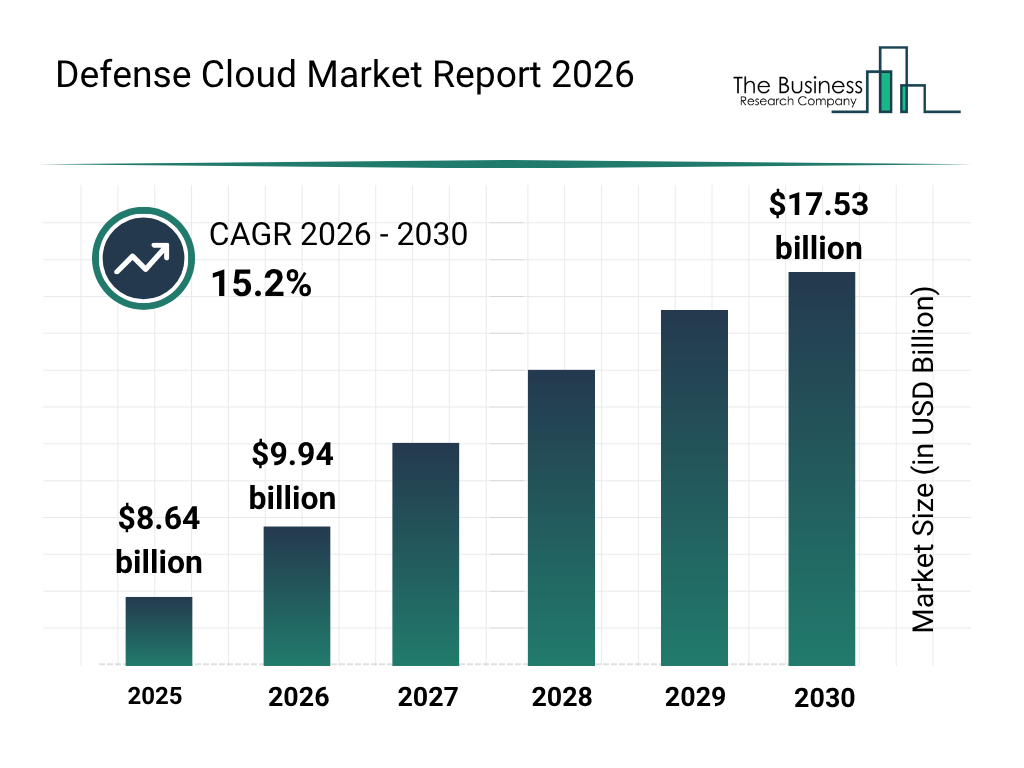
The defense cloud market has experienced swift growth in recent years, with its size expected to rise from $8.64 billion in 2025 to $9.94 billion in 2026, marking a compound annual growth rate (CAGR) of 15.0%. Historically, this expansion has been propelled by reliance on traditional on-premise defense IT infrastructures, escalating geopolitical conflicts, ongoing defense modernization programs, increased cyber threats targeting military networks, advancements in digital intelligence and surveillance technologies, and early adoption of virtualization within government defense systems.
Download a free sample of the defense cloud market report:
https://thebusinessresearchcompany.com/sample_request?id=51560998&type=smp&name=Defense%20Cloud%20Market%20Report%202026&utm_source=EINPresswire&utm_medium=Paid&utm_campaign=Sep_PR
Future Growth Outlook Reflecting Technological Advancements
Looking ahead, the defense cloud market is forecasted to expand significantly, reaching $17.53 billion by 2030 with a CAGR of 15.2%. This projected growth is driven by the rising integration of AI-powered defense analytics and autonomous decision support systems, broader adoption of edge computing to enhance battlefield operations, growing demand for interoperable, multinational defense cloud platforms, stricter cybersecurity regulations and zero-trust policies in defense sectors, as well as the proliferation of satellite-based secure communication networks. Key trends during this period will include multi-domain secure cloud deployments for critical defense tasks, increased use of hybrid and private cloud models tailored for military needs, deeper incorporation of zero-trust cybersecurity frameworks, expansion of real-time battlefield data analytics and intelligence sharing tools, and a surge in cloud-based command and control systems facilitating coordinated missions.
Defining the Defense Cloud and Its Role in Military Operations
The defense cloud is a specialized, secure cloud computing environment developed explicitly for defense and military organizations. It serves as a platform for securely storing, managing, and processing sensitive defense data and applications. This infrastructure supports critical activities such as real-time data exchange, mission planning, cybersecurity operations, intelligence analysis, and command-and-control functions across defense networks, enhancing operational efficiency and responsiveness.
View the full defense cloud market report:
https://www.thebusinessresearchcompany.com/report/defense-cloud-market-report?utm_source=EINPresswire&utm_medium=Paid&utm_campaign=Sep_PR
Increasing Defense Digital Transformation as a Growth Catalyst
One of the primary forces propelling the defense cloud market is the surge in defense digital transformation initiatives. These government and military-led programs focus on modernizing armed forces through the deployment of advanced technologies like cloud computing, artificial intelligence, and sophisticated cybersecurity measures. The complexity of contemporary warfare and the imperative for instant data sharing are driving defense agencies to move away from aging IT systems and adopt more flexible, cloud-based solutions. This shift inherently boosts the demand for scalable, secure, and interoperable cloud infrastructures essential for mission-critical operations. For example, in May 2023, the US Department of Defense allocated $45 billion for IT investments and an additional $13.5 billion for cyber activities, illustrating a significant increase from its $55.2 billion budget in fiscal 2023. Such substantial funding underscores the emphasis on digital transformation efforts that fuel growth in the defense cloud market.
North America Leading While Asia-Pacific Emerges as the Fastest Growing Region
In terms of regional market share, North America was the dominant player in the defense cloud sector in 2025. However, the Asia-Pacific region is anticipated to exhibit the fastest growth throughout the forecast period. The defense cloud market analysis covers a broad geographic scope including Asia-Pacific, South East Asia, Western Europe, Eastern Europe, North America, South America, the Middle East, and Africa, reflecting a global landscape of dynamic opportunities and evolving demands.
Our 2026 reports feature deeper market intelligence with market attractiveness scoring and analysis, total addressable market (TAM) analysis, company scoring matrix graphics and tables, Excel-based forecasting dashboards, market hotspots infographics, key technologies and future trend analysis, and updated graphics and tables.
Speak With Our Expert:
Saumya Sahay
Americas +1 310-496-7795
Asia +44 7882 955267 & +91 8897263534
Europe +44 7882 955267
Email: marketing@tbrc.info
The Business Research Company - www.thebusinessresearchcompany.com
Follow Us On:
• LinkedIn: https://in.linkedin.com/company/the-business-research-company
Oliver Guirdham
The Business Research Company
+44 7882 955267
email us here
Visit us on social media:
LinkedIn
Facebook
X
Legal Disclaimer:
EIN Presswire provides this news content "as is" without warranty of any kind. We do not accept any responsibility or liability for the accuracy, content, images, videos, licenses, completeness, legality, or reliability of the information contained in this article. If you have any complaints or copyright issues related to this article, kindly contact the author above.
