

Pervaziv AI Expands Cortex Enterprise AI with Salesforce CRM, Connecting Customer Context to Secure Software Delivery
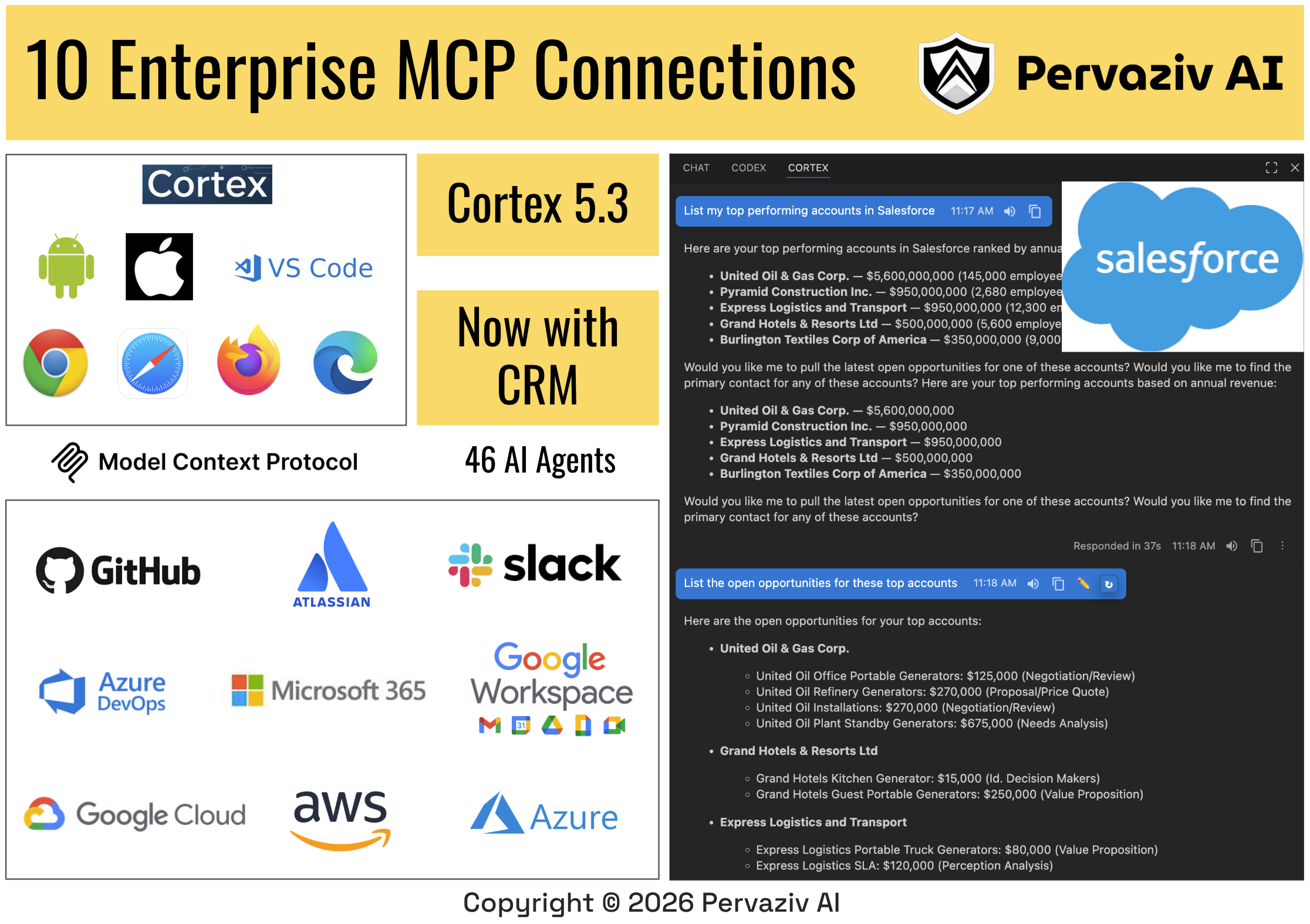
Cortex 5.3 with Salesforce CRM

Tenth enterprise MCP connection brings accounts, contacts, opportunities, cases and CRM workflows into Cortex across developer, browser, and mobile experiences.
SAN FRANCISCO , CA, UNITED STATES, July 24, 2026 /EINPresswire.com/ -- Pervaziv AI today announced Salesforce CRM support in Cortex, expanding the company’s Enterprise AI ecosystem with its tenth Model Context Protocol, or MCP, connection and adding a new customer and revenue dimension to connected software delivery.
Cortex already connects authorized users with the systems where engineering, security, operational, and organizational context lives, including GitHub, Atlassian, Slack, Azure DevOps, Microsoft 365, Google Workspace, Google Cloud, Amazon Web Services, and Microsoft Azure. Salesforce CRM extends that connected workspace to customer accounts, stakeholders, opportunities, support cases, standard and custom objects, and the business relationships that frequently influence technical priorities.
The new capability is designed to help organizations bring approved CRM context into the same AI-assisted environment used to build, secure, deploy, operate, and support modern software. Rather than treating customer information and technical execution as separate workflows, Cortex can help authorized teams move from a customer question to the engineering, security, delivery, or cloud context needed to act.
This release builds on Pervaziv AI’s broader multicloud and connected enterprise direction. Cortex 3.2 introduced AWS integration, bringing cloud infrastructure into code and security workflows. Cortex 3.5 expanded that vision across AWS, Microsoft Azure, and Google Cloud. Salesforce CRM now adds the customer relationship layer, creating a more complete path from business impact to technical resolution.
## Executive Commentary
------------------------------------
“Enterprise software decisions do not begin and end in the codebase,” said Anoop Jaishankar, Founder and CEO of Pervaziv AI. “They are shaped by customer impact, support history, delivery commitments, security risk, cloud operations, and the people responsible for the outcome. Salesforce gives Cortex a critical business context layer that can connect those signals with the technical systems where work actually happens.”
Jaishankar continued, “Our vision for Cortex is an Enterprise AI Control Layer that helps organizations reason and act across systems without losing permission boundaries, governance, traceability, or human intent. By bringing Salesforce CRM into the same ecosystem as GitHub, Atlassian, collaboration platforms, productivity systems, and the three major clouds, we are helping teams move from fragmented information to coordinated action. This is not about replacing Salesforce or any system of record. It is about making the right authorized context available when a customer, engineering, security, or operational decision must be made.”
## From Engineering Context to Customer Context
---------------------------------------------------------------------
Enterprise work rarely stays inside one application.
A product team may receive a high-priority customer report in Salesforce, review the account’s open cases and escalation history, inspect related implementation details in GitHub, validate a deployment in AWS or Azure, review a project item in Jira, and coordinate next steps through Slack or Microsoft 365.
Each system contains a piece of the answer, yet teams often spend substantial time manually searching, reconciling details, and transferring context between customer-facing and technical groups.
Salesforce CRM support in Cortex is designed to reduce that fragmentation. Authorized users can bring relevant customer information into existing AI-assisted workflows and connect it with the technical context available through other approved Cortex connections.
The goal is not to create another isolated CRM interface. The goal is to help teams understand why technical work matters, who is affected, what commitments may be involved, and which systems or teams need to participate in the response.
## Introducing the Salesforce CRM Connection
---------------------------------------------------------------
The Salesforce connection is intended for organizations seeking closer alignment among sales, customer success, support, product, engineering, security, delivery, and cloud operations.
Through a conversational experience, Cortex can help authorized users work with common Salesforce CRM information, including:
Accounts and account relationships
Contacts and customer stakeholders
Opportunities and commercial context
Cases and customer support context
Standard and custom Salesforce objects
Object fields, relationships, and metadata
Salesforce queries and search results
Individual CRM record details
Users can begin with broad questions and progressively narrow the request. A team member might identify an account, review open cases, inspect related opportunities, locate key contacts, explore a custom object, or understand available fields before constructing a focused query.
When organizational policies, permissions, and user intent allow it, Cortex can also assist with explicitly requested record creation or updates. Operational actions remain tied to the authorized Salesforce connection and the controls established by the organization.
## Practical Salesforce Use Cases
---------------------------------------------
Customer Issue Investigation
A support, engineering, security, or operations team can begin with a customer account and its open Salesforce cases. Cortex can help surface relevant customer context before the team investigates logs, code, deployment history, infrastructure state, or security findings in connected technical systems.
This can reduce the time spent manually reconciling account details with the engineering environment. It can also give technical teams a clearer understanding of the customer impact before they prioritize, diagnose, and communicate a resolution.
Account-Aware Engineering Support
Engineering teams frequently need to understand the operational and commercial significance of a bug, vulnerability, deployment problem, or service degradation. Salesforce context can help answer questions such as:
Which customer reported the issue?
Are there related cases or a history of escalation?
Which contacts are associated with the account?
Is there an active opportunity or customer commitment that affects priority?
Have other accounts reported similar behavior?
By bringing those answers closer to the engineering workflow, Cortex can help teams assess urgency with a more complete view of the situation.
CRM Data Discovery
Enterprise Salesforce environments often contain custom objects, custom fields, specialized relationships, and organization-specific naming conventions. These environments can be difficult for occasional users, technical teams, and new employees to navigate.
Cortex can help authorized users discover available objects, examine schemas, understand fields and relationships, and retrieve focused information. This is useful for developers integrating Salesforce data with internal applications, customer operations teams supporting technical programs, and cross-functional teams working in an unfamiliar CRM environment.
Revenue and Delivery Coordination
Customer commitments frequently depend on engineering delivery. A requested feature, implementation milestone, security remediation, integration dependency, or deployment date may have direct implications for an opportunity or customer relationship.
With Salesforce available alongside project management, source control, collaboration, productivity, and cloud connections, Cortex can help teams connect account and opportunity context to the delivery work underway.
A user might review an opportunity, identify the related account, inspect open cases, locate associated delivery work, and coordinate the next action through connected organizational tools.
Safer CRM Updates
CRM changes can influence customer communication, forecasting, support activity, and business processes, so updates should be deliberate.
Cortex is designed to keep user intent central to operational actions. When a user explicitly requests a permitted record creation or update, Cortex can help prepare and execute that action through the authorized Salesforce connection.
Organizations continue to control access policies, data visibility, user permissions, and which operational workflows are available.
## Salesforce CRM Across Cortex Work Surfaces
----------------------------------------------------------------
Salesforce CRM support is available across Cortex work surfaces, including developer environments, browser-based workflows, and mobile experiences. This gives teams flexibility to access approved CRM context where it is most useful.
A developer investigating a production problem can access relevant account or case information from a coding workflow.
A support or operations user can work from the browser while coordinating with engineering colleagues.
A mobile user can review customer and operational context while away from a primary workstation.
The experience is designed to remain consistent across these environments while respecting the access controls, permissions, and data visibility configured for the connected organization.
## Bringing Customer Context into Secure Software Delivery
--------------------------------------------------------------------------------
Customer data is often an important input to engineering and security decisions, yet it is frequently disconnected from the technical systems used to resolve issues.
Salesforce CRM support helps bridge that gap by connecting authorized customer-facing context with software delivery context across source control, project tracking, collaboration systems, productivity platforms, and cloud environments.
Teams can use this connected context to explore questions such as:
Is a production issue affecting a strategic customer?
Are open cases associated with the account?
Has the customer reported similar behavior previously?
Does a deployment, configuration change, or security remediation require customer communication?
Which teams need to coordinate before the issue can be closed?
By giving authorized users a clearer view of CRM and technical context, Cortex can help reduce delays caused by fragmented information and incomplete handoffs.
## Permission-Aware Enterprise Workflows
----------------------------------------------------------
Enterprise AI must operate within boundaries established by the organization.
Cortex uses authorized connections to access systems a user is permitted to use. Salesforce CRM access is therefore governed by the permissions, policies, and data visibility available to the connected Salesforce user and organization.
This approach is intended to help enterprises adopt AI-assisted workflows while retaining control over customer data, business processes, and operational actions. Cortex does not grant independent access to Salesforce information outside those authorized boundaries.
For sensitive environments, organizations can begin with discovery and read-oriented workflows. These may include:
Reviewing account information
Searching CRM records
Examining support cases
Understanding object structures
Retrieving selected record details
Organizations can then selectively enable approved operational workflows as governance requirements and internal policies permit.
## A Salesforce Specialist Within the Cortex Ecosystem
--------------------------------------------------------------------------
Salesforce CRM support gives Cortex a dedicated enterprise capability for CRM data and workflows.
The Salesforce-focused experience is designed to understand common tasks such as:
Account discovery
Contact and opportunity lookup
Case review
Object exploration
Schema understanding
Query preparation
Structured record operations
It can help users turn broad business questions into focused requests and move from a general concern to the specific records needed for the next decision.
This specialization complements Cortex capabilities across software development, security, collaboration, productivity, and cloud operations. Rather than treating CRM as an isolated data source, Cortex can help authorized users connect customer information to the technical work that follows.
## Illustrative Enterprise Scenarios
-----------------------------------------------
Investigating a High-Priority Customer Incident
A team can begin with the customer account and open support cases in Salesforce. Cortex can then help guide the investigation through the connected engineering and cloud environment, including relevant repository context, delivery status, operational information, and remediation activity.
This creates a more connected path from customer impact to technical diagnosis and resolution.
Preparing for a Customer Escalation
Before an escalation meeting, a user can review the relevant account, contacts, opportunities, and open cases. Cortex can help organize that CRM context alongside current work in engineering, project management, and collaboration systems.
Teams can enter the discussion with a clearer picture of what the customer is experiencing, what has already occurred, what work is underway, and which decisions remain open.
Understanding Custom CRM Data
Many organizations tailor Salesforce with objects and fields that reflect their own products, customer lifecycles, support processes, and revenue operations.
Cortex can help authorized users explore those structures, identify relevant fields, understand relationships, and retrieve the information needed for a specific workflow.
This can make complex Salesforce environments more accessible to technical and operational users without requiring them to begin with detailed knowledge of every custom schema.
Coordinating Customer-Driven Product Work
Customer requests often generate work across product, engineering, security, documentation, delivery, and operations.
Salesforce CRM context can establish the account, stakeholder, opportunity, and case background. Other Cortex connections can help teams coordinate project work, inspect source changes, locate documentation, communicate decisions, and understand cloud or operational dependencies.
The result is a more continuous workflow from customer request to product outcome.
## Ten Enterprise MCP Connections in Cortex
-------------------------------------------------------------
Salesforce becomes the tenth enterprise MCP connection in Cortex:
GitHub
Atlassian
Slack
Azure DevOps
Microsoft 365
Google Workspace
Google Cloud
AWS
Microsoft Azure
Salesforce CRM
Together, these connections support a broader model of Enterprise AI that can work across source code, delivery pipelines, documentation, collaboration, productivity systems, cloud infrastructure, and customer operations.
The importance of this ecosystem is not simply the number of available connections. Its value comes from helping users combine the right approved context from systems that shape real enterprise decisions.
## Enterprise AI with Connected Context
-------------------------------------------------------
Connected AI becomes more useful when it can provide the right context at the moment a decision must be made.
Salesforce adds a critical business layer to Cortex. Engineering teams can gain a clearer understanding of customer impact. Customer-facing teams can better understand technical status. Security and operations teams can incorporate authorized account and case context into investigations. Product and leadership teams can reduce friction between customer commitments and technical execution.
The addition also extends the trajectory established by Cortex 3.2 and Cortex 3.5. AWS support connected infrastructure with code and security. Multicloud support expanded that control layer across AWS, Azure, and Google Cloud. Salesforce CRM now links customer relationship intelligence with the systems used to deliver and operate software.
As Cortex expands across enterprise platforms, Pervaziv AI’s focus remains consistent: help organizations build, secure, operate, support, and scale software with better context, stronger coordination, and controlled AI-assisted workflows.
Salesforce CRM support is the next step in that journey, moving Cortex closer to an enterprise environment where customer priorities and technical action can be understood together.
## Availability
------------------
Salesforce CRM support is available as part of the growing Cortex Enterprise AI connection ecosystem. Access to Salesforce data and operational capabilities depends on organizational configuration, connected-user permissions, applicable policies, and enabled workflows.
## About Pervaziv AI
-----------------------------
Pervaziv AI is an Enterprise AI and cybersecurity company building Cortex, an Enterprise AI Control Layer for secure software development, security workflows, cloud operations, and connected organizational work.
Cortex brings AI assistance closer to the systems where teams build, deploy, secure, operate, and support software, helping organizations work with stronger context, privacy, governance, traceability, and control.
Pervaziv AI
Pervaziv AI
email us here
Visit us on social media:
LinkedIn
Instagram
YouTube
X
Legal Disclaimer:
EIN Presswire provides this news content "as is" without warranty of any kind. We do not accept any responsibility or liability for the accuracy, content, images, videos, licenses, completeness, legality, or reliability of the information contained in this article. If you have any complaints or copyright issues related to this article, kindly contact the author above.
