

Taction Software Expands Healthcare App Development Practice With Deep EHR/EMR Integration and FDA-Ready Mobile Apps
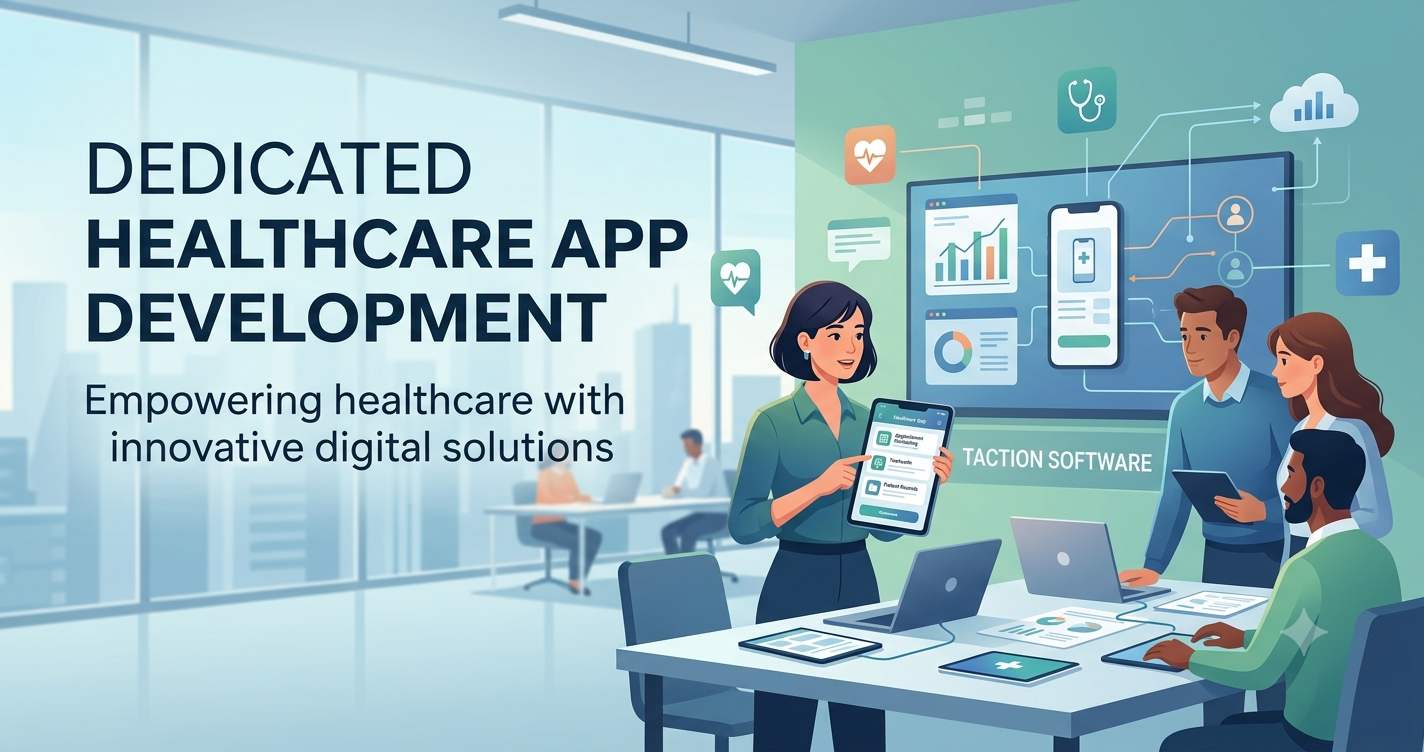
Healthcare app development PR

Healthcare IT USA
Taction Software LOGO
Healthcare IT company brings HL7, FHIR, and Mirth Connect integration expertise to HIPAA-compliant mobile apps for hospitals, clinics, and healthtech startups.
Over more than a decade of work in healthcare technology, Taction Software has focused on a problem that sits at the center of digital health: a mobile application only delivers value when it can exchange data securely and reliably with the clinical systems that providers already use every day. A patient-facing app that cannot connect to an electronic health record, a remote monitoring tool that cannot deliver structured data back to a clinician, or a billing application that cannot reconcile with existing records all fall short of their purpose. Taction Software's expanded practice is built specifically to close that gap, pairing app design and engineering with standards-based integration.
The Interoperability Imperative in Healthcare Apps
Healthcare has moved steadily toward connected, data-driven care, and that shift has raised the bar for what a healthcare application must do. It is no longer enough for an app to present a clean interface or to track a single metric. The applications that matter to hospitals, clinics, and healthtech companies are the ones that fit into a real clinical environment, sharing information across the systems that clinicians, administrators, and patients rely on.
That requirement places interoperability at the heart of modern healthcare app development. The ability to move patient and clinical data safely between an app and an electronic health record, a laboratory system, a billing platform, or a remote monitoring device is what separates a useful clinical tool from a standalone product that sits on the edge of the workflow. Taction Software has built its healthcare app practice around this principle, treating integration not as an afterthought but as a core part of how an application is designed from the first planning session.
EHR and EMR Integration Across Leading Platforms
At the center of the company's healthcare app capability is its experience connecting applications to leading electronic health record and electronic medical record platforms. Taction Software helps healthcare organizations connect applications with major EHR and EMR systems, including Epic, Cerner, eClinicalWorks, Athenahealth, NextGen, and Veradigm and Allscripts. These integrations are built using established healthcare interoperability standards and tools, including HL7, FHIR, CCDA, secure APIs, and Mirth Connect-based integration workflows.
Each of these standards plays a distinct role. HL7, in both its version 2 and version 3 forms, remains the established messaging standard for exchanging clinical data between healthcare systems. FHIR, the Fast Healthcare Interoperability Resources standard, is the modern, API-first approach designed for web and mobile applications, and it has become central to how new healthcare apps connect to clinical data. CCDA supports the structured exchange of clinical documents, while Mirth Connect serves as a flexible interface engine that routes, transforms, and manages healthcare messages between systems. Taction Software applies the right combination of these standards based on the systems a client already runs, rather than forcing a single approach onto every project.
The result is that applications built by the company can participate in a healthcare organization's data environment rather than standing apart from it. Patient information, clinical results, scheduling data, and billing records can move securely between the app and the systems of record, supporting more informed decisions and more connected care. For healthcare organizations evaluating an app development partner, this integration depth is often the deciding factor, because the technical challenge of secure, standards-based interoperability is one that general mobile app developers are rarely equipped to handle.
A Full Range of Healthcare Applications
Taction Software builds HIPAA-compliant applications across a broad range of healthcare use cases, reflecting the diversity of needs across the industry. The company develops telehealth and telemedicine apps that support secure video consultations, scheduling, and electronic prescriptions, extending access to care beyond the walls of a clinic. It builds patient engagement applications, including portals, reminders, and secure messaging that help patients stay informed and adherent between visits, which can support better outcomes and reduce missed appointments.
The company also develops chronic disease management apps that help patients manage long-term conditions such as diabetes, hypertension, and asthma through medication alerts, health logs, and provider dashboards that support continuity of care. Its remote patient monitoring and remote therapeutic monitoring applications capture patient-reported and device data and deliver structured summaries to clinicians, supporting both better visibility into patient status and the reimbursement workflows associated with these care models. In the behavioral health space, the company builds mental health and therapy applications designed around the confidentiality requirements that govern this sensitive area of care.
Beyond these categories, Taction Software develops EHR and EMR connected applications that bring real-time clinical data into the hands of providers and patients, medication management and adherence tools, pharmacy and electronic prescription applications, healthcare tracking and wellness apps, and applications that connect to wearables and Internet of Things devices for real-time health data. The breadth of this work reflects a deliberate strategy: rather than specializing in a single narrow category, the company has developed the engineering and compliance foundations that allow it to serve the full spectrum of healthcare app needs while maintaining a consistent standard of security and interoperability.
Compliance and Security Engineered From the Start
In healthcare technology, security and regulatory compliance are not features that can be added near the end of a project. They must be designed into the architecture of an application from the very beginning. Taction Software builds healthcare software aligned with HIPAA, HITECH, GDPR, FDA Software as a Medical Device readiness, FISMA requirements, SOC 2 controls, and ISO 27001 information-security practices.
Each of these frameworks addresses a different dimension of trust. HIPAA and HITECH govern the privacy and security of protected health information in the United States, setting the rules for how patient data must be handled, stored, and shared. GDPR extends similar protections for users in the European Union. FDA Software as a Medical Device readiness matters for applications that function as medical devices and must meet regulatory expectations. FISMA requirements apply to systems that interact with federal information, SOC 2 controls address the security, availability, and confidentiality of customer data, and ISO 27001 represents an internationally recognized standard for information security management.
Across its applications, Taction Software incorporates encryption, role-based access control, audit logging, and privacy-by-design into the architecture from the start. This approach means that compliance is not a document produced at the end of development but a property of the system itself, reflected in how data is stored, who can access it, and how every action is recorded. For healthcare organizations, this engineering discipline reduces risk and supports the trust that patients and regulators place in digital health tools.
Proof in Real Healthcare Applications
The company's healthcare app capability is reflected in the products it has delivered across multiple healthcare domains. A recent example is Revive Ease, an AI-powered chronic pain tracking and coaching application. The app helps patients log pain, activity, sleep, and recovery between visits, and it generates structured patient-reported summaries that support providers' remote therapeutic monitoring workflows. By giving patients a structured way to record their experience and giving clinicians clear, organized data to review, the application supports more informed care for people managing chronic pain. Revive Ease is live on the Apple App Store and Google Play and is FDA Registered as a Class 1 device, a verifiable indicator of the regulatory diligence behind the product.
Taction Software's healthcare app and integration work spans other domains as well. The company has delivered EHR and EMR development supporting revenue cycle management operations, where accurate, well-structured clinical and billing data is essential to efficient, automatable processes. It has also built a secure coordination platform and companion application for behavioral health peer support specialists, helping those specialists collaborate and share health information within a privacy-sensitive environment. Together, these projects demonstrate range across consumer-facing chronic care, revenue cycle and billing operations, and behavioral health coordination, three distinct areas of healthcare that each carry their own workflows and requirements.
The Difference of Real Healthcare IT Depth
What distinguishes Taction Software in a crowded field of app developers is its foundation in healthcare information technology rather than general mobile app development alone. The company has worked in healthcare integration, interoperability, and clinical data exchange for more than a decade, and that background shapes how it approaches every healthcare app. Where a general app developer may treat integration as an external dependency, Taction Software treats it as a core competency, applying hands-on experience with HL7, FHIR, and Mirth Connect to ensure that applications connect cleanly to the systems that matter.
This depth has practical consequences for clients. It means an application can be planned with a realistic understanding of how it will exchange data with an electronic health record, what compliance obligations apply, and how to structure the system so that it remains secure and maintainable as it grows. It also means that the company can serve as a single partner across the full lifecycle of a healthcare application, from initial strategy and design through development, integration, compliance, and ongoing support, rather than requiring a client to assemble multiple vendors to cover the technical and regulatory complexity of healthcare.
A Collaborative, Transparent Development Approach
Taction Software follows an agile and transparent development approach, with iterative delivery, continuous updates, and open communication at every stage of a project. This process keeps clients involved as an application takes shape, allowing requirements to be refined and priorities to be adjusted as the product develops. For healthcare organizations, where regulatory requirements and clinical workflows can be complex, this collaborative model helps ensure that the final application reflects both the technical realities of integration and the practical needs of the people who will use it.
The company supports a range of engagement models, including fixed-price projects, dedicated teams, and staff augmentation, so that healthcare organizations and healthtech startups can structure an engagement in the way that best fits their needs and resources. This flexibility allows the company to work with established hospitals and clinics as well as early-stage startups building their first product.
Leadership Perspective
"Healthcare apps only deliver value when they connect securely to the systems care teams depend on," said Arinder Singh Suri, Chief Executive Officer of Taction Software. "Our background in healthcare IT and interoperability means we build apps that fit into a real clinical environment, not standalone tools that sit on the edge of it."
"The organizations we work with are not looking for an app for its own sake," Suri added. "They are looking for technology that improves care, fits their workflows, and meets the security and compliance standards that healthcare demands. That is the standard we hold ourselves to on every project, and it is why we have built our practice around integration and compliance rather than treating them as add-ons."
AI and Emerging Technology in Healthcare Apps
Alongside its integration and compliance work, Taction Software applies artificial intelligence and emerging technologies where they add genuine clinical or operational value. The company's experience with healthcare AI is reflected in applications such as Revive Ease, where AI supports chronic pain tracking and coaching by helping turn day-to-day patient input into structured, useful information. Rather than adding technology for its own sake, the company focuses on applications where intelligent features can improve the experience for patients and the quality of information available to providers, such as symptom guidance, pattern recognition in patient-reported data, and the generation of clear summaries that clinicians can act on.
The company also works with cloud platforms, secure data pipelines, and analytics technologies that allow healthcare applications to scale reliably and to support reporting and insight without compromising security. By combining these capabilities with its core integration and compliance foundations, Taction Software is able to build applications that are not only functional at launch but also positioned to grow and adapt as a healthcare organization's needs evolve. This forward-looking approach reflects the reality that healthcare technology rarely stands still, and that an application built today should be ready for the data, the integrations, and the regulatory expectations of tomorrow.
Serving Startups and Established Healthcare Organizations
Taction Software works across the full spectrum of organizations that build healthcare applications, from early-stage healthtech startups developing their first product to established hospitals, clinics, and enterprises modernizing their digital tools. For startups, the company offers the healthcare engineering and compliance experience that can be difficult to assemble in-house, helping founders move from concept to a market-ready, compliant application without underestimating the regulatory and integration challenges unique to healthcare. The company's flexible engagement models allow these clients to structure a project around their stage and resources.
For established healthcare organizations, Taction Software brings the ability to build applications that connect into existing clinical and operational systems, modernize legacy tools, and extend services to patients and staff through secure mobile experiences. In both cases, the company applies the same standards of security, interoperability, and clinical relevance, ensuring that whether an application serves a single new product idea or a large healthcare network, it is built to fit into a real healthcare environment. This range of clients has given the company exposure to a wide variety of workflows and requirements, experience that informs every new project it undertakes.
Looking Ahead
As healthcare continues to adopt connected technologies, the demand for applications that combine strong user experience with deep clinical integration is expected to grow. Taction Software intends to continue investing in the standards-based integration capabilities, security practices, and healthcare engineering experience that allow it to build applications fit for real clinical environments. The company sees its role as helping healthcare organizations and healthtech innovators bring secure, connected, compliance-ready applications to the people who depend on them, from patients managing their own health to the clinicians and care teams who serve them.
Organizations interested in building a connected, compliant healthcare application can learn more on the company's healthcare app development services page.
About Taction Software
Taction Software is a healthcare IT company founded in 2013 that builds HIPAA-compliant healthcare mobile apps for hospitals, clinics, healthtech startups, and enterprises. The company pairs app development with deep EHR and EMR integration expertise across HL7, FHIR, CCDA, and Mirth Connect, helping healthcare organizations launch secure, connected, compliance-ready applications. Learn more about Taction Software's healthcare app development services.
arinder singh suri
Taction Software LLC
+ +1 307 459 0850
email us here
Visit us on social media:
LinkedIn
Instagram
Facebook
YouTube
X
Other
Legal Disclaimer:
EIN Presswire provides this news content "as is" without warranty of any kind. We do not accept any responsibility or liability for the accuracy, content, images, videos, licenses, completeness, legality, or reliability of the information contained in this article. If you have any complaints or copyright issues related to this article, kindly contact the author above.
